
Local SEO in 2026: Optimising for the Answer Engine Era
Table of Contents
Local SEO In 2026 no longer revolves around ranking webpages or driving clicks as the primary measure of success. Local visibility is now shaped by whether modern search systems can confidently recommend a business as the correct local answer, often without sending a user to a website.
When someone asks their phone, car, or assistant, “Who should I choose near me?”, the response is increasingly delivered as a single recommendation, supported by a short explanation, a map location, or a spoken answer. In many cases, the interaction ends there.
This article explains how Local SEO In 2026 actually works, why traditional SEO thinking is no longer sufficient, and what local businesses must do to remain visible in an environment shaped by answer engines rather than lists of links.
Key Takeaways
Local SEO In 2026 focuses on helping AI-driven systems confidently recommend local businesses rather than ranking websites. Visibility now depends on entity clarity, consistent business information, verified real-world experience, and trust signals across the web. Search platforms increasingly act as answer engines, delivering direct recommendations through business profiles and summaries. Businesses that reduce uncertainty and accurately reflect their real-world operations are more likely to be selected as local answers.
Local search has not disappeared — it has changed its purpose.
Rather than helping users compare multiple options, modern search systems increasingly aim to resolve local intent as quickly and accurately as possible. Platforms operated by companies such as Google are designed to reduce friction, not extend journeys. The emphasis has shifted from browsing to confident decision-making.
Where users were once presented with a list of similar businesses, they are now often given a single recommendation, supported by brief context such as proximity, availability, or relevance. This is not a cosmetic change to search results; it reflects a deeper shift in how local information is evaluated and delivered.
This evolution can be understood as three related transitions:
- From exploration to resolution
Search experiences increasingly aim to answer the question immediately, rather than encourage further investigation. - From rankings to recommendations
Visibility is no longer about position among competitors, but about being selected as the most reliable option. - From optimisation to verification
Signals that reduce uncertainty — accuracy, consistency, and real-world confirmation — now matter more than traditional optimisation tactics.
In Local SEO In 2026, the central challenge has changed. The defining question is no longer “How do I rank higher?” but “How do I make it easy for search systems to trust and recommend my business?”
That shift underpins every other change in modern local search.
Why Clicks Are No Longer the Primary Metric
For many years, SEO success was assessed almost entirely through visible interaction metrics. Rankings, organic traffic, and click-through rates were treated as direct indicators of performance and progress. If a page attracted visits, it was considered successful.
In Local SEO In 2026, this model no longer reflects how local discovery actually works.
Many local searches now resolve before a website visit occurs. A user may receive a recommendation and take action immediately — calling a business, requesting directions, saving a location, or acting on a spoken response from a device or in-car system. In these cases, the decision is made without clicking through to any page.
This does not mean websites have lost their importance. It means their function has changed.
Websites now operate primarily as a verification layer. They provide depth, context, and reassurance, even when users never consciously engage with them. Search systems reference websites to confirm business details, understand services, and assess credibility, but the website is no longer always the final step in the journey.
As a result, measuring success in Local SEO In 2026 requires a shift in perspective. Visibility and influence often occur upstream, shaping decisions without producing traditional engagement signals. A lack of clicks does not necessarily indicate failure; in many cases, it reflects that the system was confident enough to resolve the user’s intent without further interaction.
Understanding this change is essential for interpreting performance accurately and avoiding strategies that optimise for traffic at the expense of trust.
From Keywords to Entities: How Local Businesses Are Understood
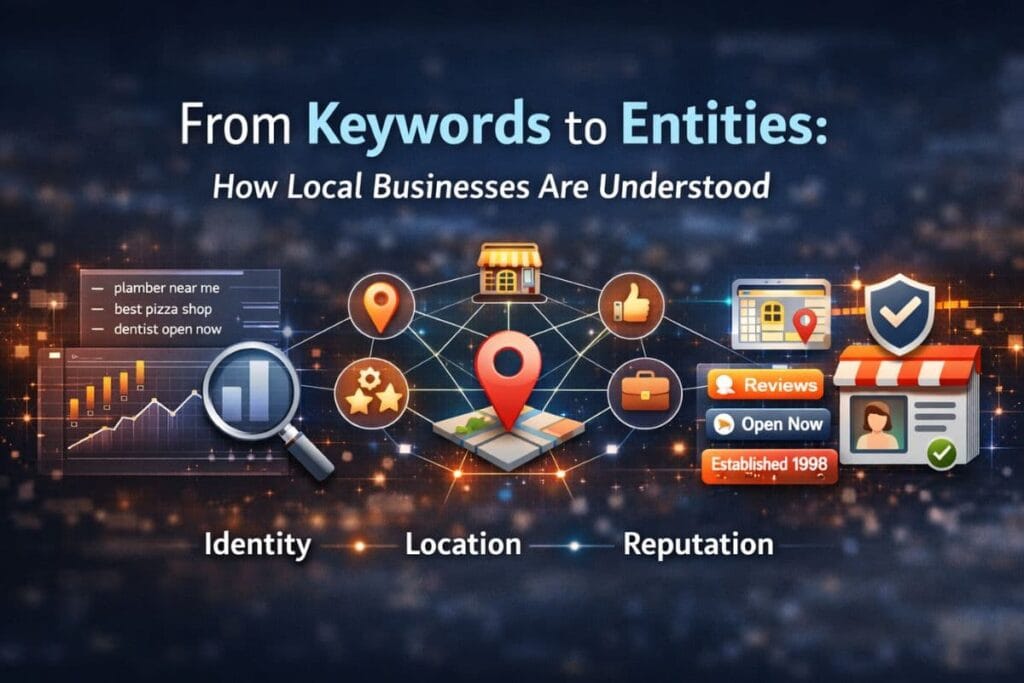
At the core of Local SEO In 2026 is the concept of entities.
An entity is a clearly identifiable real-world object — such as a local business — that search systems can recognise, describe, and distinguish from others. Unlike keywords, which are abstract and context-dependent, entities are anchored in verifiable facts.
For local businesses, an entity is defined by a stable set of attributes, including:
- Business name
- Physical location
- Services offered
- Operating details
- Reputation and public perception
Modern search systems no longer rely on matching pages to search terms in isolation. Instead, they attempt to construct a coherent profile of a business by cross-checking information across multiple sources, such as:
- Websites
- Business profiles
- Reviews
- Directories
- Independent third-party mentions
Each source acts as a confirmation point. When the same information appears consistently across these surfaces, confidence increases. When details conflict — even slightly — uncertainty is introduced.
This is why the objective in Local SEO In 2026 is not keyword relevance, but entity certainty.
A business does not become visible by repeating the right phrases. It becomes visible because search systems can confidently answer basic questions about it: who it is, what it does, where it operates, and whether that information can be trusted.
When those signals align, a business is easier to recommend. When they do not, visibility is reduced — not as a penalty, but as a precaution. In an environment where search systems aim to provide direct answers, uncertainty is something they are designed to avoid.
Understanding this shift is essential. It explains why consistency now matters more than optimisation, and why even well-written content can underperform if it introduces ambiguity rather than clarity.

Experience as a Trust Signal
Experience as a trust signal refers to observable, real-world proof that a local business actively serves customers, demonstrated through reviews, images, service confirmations, and consistent activity across trusted platforms.
AI-driven systems are highly effective at summarising established knowledge and common advice. What they cannot reliably replicate is first-hand, situational experience, particularly when it is tied to a specific place, context, or set of conditions.
For this reason, Local SEO In 2026 places increasing importance on experience-based signals. These signals help search systems determine whether a business genuinely performs the services it claims to offer, rather than simply describing them in theory.
Experience is most clearly demonstrated through:
- First-person explanations grounded in real work
- References to local context, conditions, or constraints
- Concrete examples drawn from actual situations
- Details that reflect how services are delivered in practice
Content rooted in real experience reduces ambiguity. It allows search systems to differentiate businesses that operate in the real world from those relying on generic or interchangeable descriptions. In an environment where recommendations are made with minimal user input, this distinction becomes essential.
Rather than acting as a stylistic choice, experience functions as a trust signal, supporting the broader goal of making local information reliable enough to recommend with confidence.
Why Generic Content No Longer Works
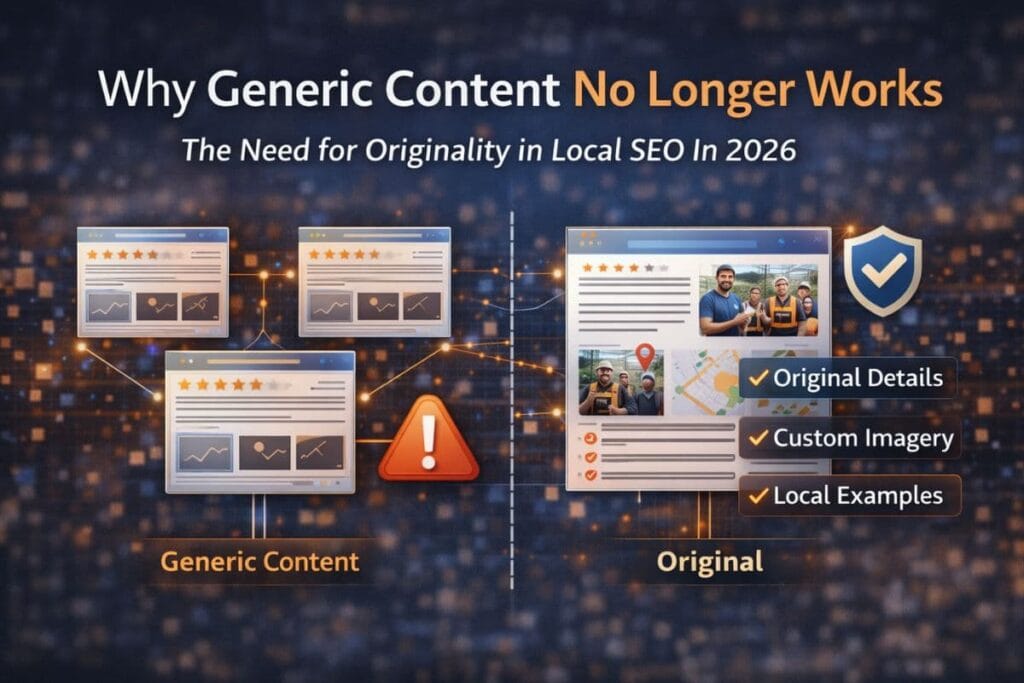
Content that could apply equally to any business introduces ambiguity rather than clarity. When explanations are interchangeable, search systems struggle to determine which business is most reliable for a specific local need.
When multiple businesses publish near-identical descriptions, several things happen:
- Meaningful differentiation becomes difficult
- Confidence in any single option is reduced
- Recommendations are more likely to be withheld
In Local SEO In 2026, originality is not about creative expression or stylistic flair. It is about specificity and grounding. Original imagery, concrete examples, and explanations tied to real local conditions help confirm that a business operates in the real world, not just online.
These details act as verification mechanisms. They reduce uncertainty and make it easier for search systems to distinguish genuine local businesses from generic or duplicated content, which is essential in an environment focused on direct recommendations rather than comparison..
Conversational Search and Answer-First Content
Search behaviour has shifted away from short, fragmented queries and toward natural, conversational language. Users increasingly ask full questions, often spoken aloud, and expect clear, immediate responses rather than a list of options to explore.
Questions such as:
- “Who offers this service near me?”
- “Which business is open right now?”
- “Who can help locally today?”
reflect intent that is specific, time-sensitive, and outcome-driven.
To align with Local SEO In 2026, content needs to accommodate this change by prioritising clarity over completeness. Effective pages reflect conversational phrasing, provide direct answers early, and expand only once the core intent has been addressed. This helps search systems identify the most relevant response without requiring further interpretation.
This answer-first structure supports summaries, voice responses, and zero-click results while remaining readable and useful for human visitors. Rather than oversimplifying content, it ensures that essential information is accessible when needed, which is increasingly how local discovery now works.
Structured Data as a Confidence Layer
Structured data does not replace high-quality content, nor does it guarantee visibility on its own. In Local SEO In 2026, its primary function is to reduce ambiguity and help search systems confirm factual details about a business.
When implemented correctly, structured data supports clarity by allowing search systems to:
- Confirm business identity and location
- Validate services and operating details
- Resolve inconsistencies between different data sources
Rather than acting as a ranking lever, schema markup works as a verification mechanism, reinforcing information that already exists on the website, Google Business Profile, and other trusted sources. This approach aligns with official guidance published by Google Search Central, which explains that structured data helps search systems better understand content but does not directly improve rankings.
In the context of Local SEO In 2026, structured data is most effective when it accurately reflects real-world operations and remains consistent with all other public-facing business information.
Authority Is Built Across the Web
Authority is no longer established on a single page or platform. In modern local search, it emerges from patterns of consistency across the wider web.
Search systems validate local businesses by comparing information from multiple sources, including:
- Website content
- Business profiles
- Reviews
- Citations and directories
- Independent third-party mentions
Each source acts as a point of confirmation. When details such as business name, services, location, and positioning align across these surfaces, trust increases. When discrepancies appear — even minor ones — uncertainty is introduced.
In Local SEO In 2026, authority is therefore cumulative rather than centralised. It is not enough to present accurate information in one place if it is contradicted elsewhere. Modern systems prioritise businesses whose public presence tells a consistent story, reinforced by multiple independent signals.
This distributed model of authority explains why consistency now outweighs optimisation. A business becomes credible not because it claims expertise, but because that expertise is corroborated across the environments where local information is expected to appear.
How Websites, Services, and Discovery Work Together
In modern local search, visibility is created through alignment rather than optimisation in isolation. Different surfaces play different roles, and each supports the others.
Business profiles are often responsible for initial discovery, especially when users receive recommendations without visiting a website. Websites then act as a confirmation layer, providing depth, context, and credibility. Service pages clarify scope, relevance, and expertise, helping search systems understand what a business actually offers and who it serves.
In practice, implementing the principles of Local SEO In 2026 requires a clear, structured approach to local SEO services, where Google Business Profile data, website content, and real-world business activity are described consistently and accurately.
When these elements reinforce one another, uncertainty is reduced. This allows modern search systems to move from recognising a business as a possibility to confidently recommending it as a local answer.nd priorities. This alignment allows systems to move from possibility to recommendation.
Measuring Success in Local SEO In 2026
Traditional SEO metrics have not disappeared, but they no longer provide a complete or reliable picture of local visibility. Rankings, traffic, and click-through rates still exist, yet they often fail to capture how modern local discovery actually influences decisions.
In Local SEO In 2026, success is increasingly reflected in outcomes rather than interactions. More meaningful indicators include:
- Growth in branded searches suggests increased recognition and trust
- Higher-quality enquiries, even if overall volume remains stable
- Increased direct calls or navigation requests
- Reduced dependence on paid advertising to maintain visibility
- Presence in answer-based or recommendation-driven search results
These signals point to influence that occurs before a website visit, not after. A business may see fewer clicks while simultaneously becoming more visible and more trusted within local search environments.
Understanding this shift is essential for accurate evaluation. Visibility in Local SEO In 2026 often shapes decisions upstream, guiding users toward a business without producing traditional engagement metrics. Measuring success, therefore, requires carefully interpreting the absence of interaction, recognising that confidence — not clicks — is increasingly the primary indicator of effective local visibility.
Common Misunderstandings About Local SEO In 2026
As local search has evolved, several assumptions from earlier SEO models continue to shape decisions — often in unhelpful ways. These misunderstandings can quietly undermine visibility, even when effort and investment are high.
Common examples include assuming that strong rankings automatically translate into visibility, treating business profiles as secondary to websites, or relying heavily on generic AI-generated content that lacks local grounding. Others focus on optimisation tactics in isolation while overlooking the importance of consistency across platforms.
Each of these approaches introduces uncertainty. When information is incomplete, inconsistent, or interchangeable, modern search systems struggle to determine which businesses can be confidently recommended.
In Local SEO In 2026, clarity matters more than complexity. Visibility is not reduced because a business has done too little optimisation, but because it has failed to present a coherent, verifiable picture of who it is, what it offers, and where it operates. Reducing uncertainty — rather than increasing effort — is often the most effective way to improve local visibility.
The Strategic Reality of Local SEO In 2026
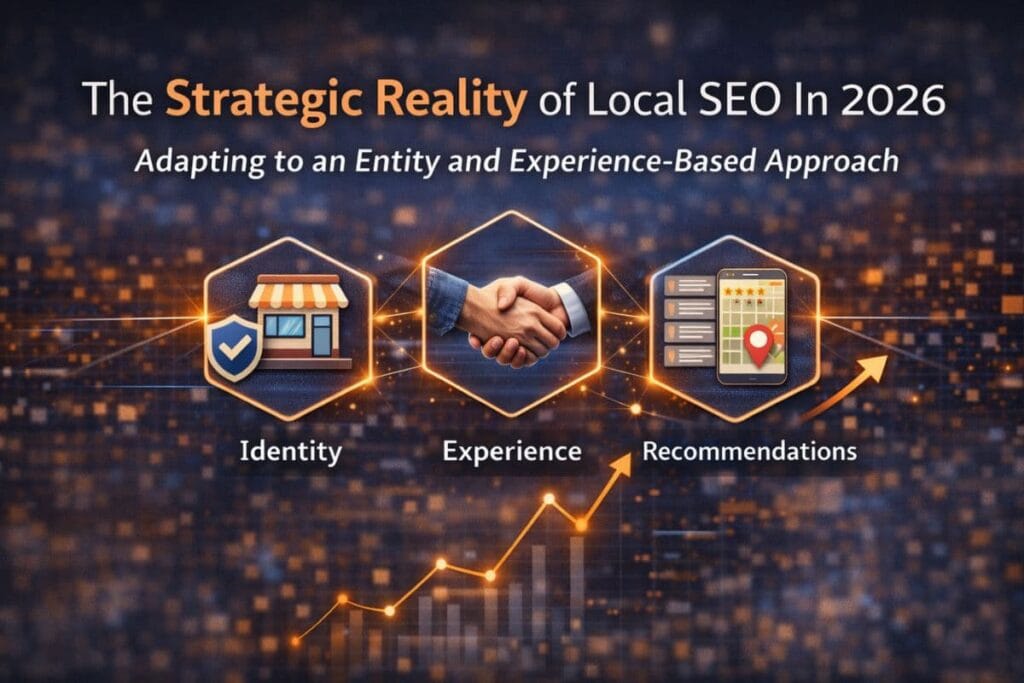
Local SEO In 2026 is not about gaming algorithms or chasing short-term tactics. It is about representing a business online in the same way it operates offline — as a reliable local institution.
Businesses that succeed in modern local search share a few defining characteristics. They are easy to verify, consistent across every surface where they appear, grounded in real-world experience, and clear about what they offer and where they operate. These qualities make it simpler for search systems to understand, trust, and recommend them.
This shift reflects a broader change in how local visibility is earned. Rather than rewarding optimisation in isolation, modern systems prioritise signals that reduce uncertainty and confirm authenticity. A business becomes visible not because it demands attention, but because it is dependable enough to be chosen without hesitation.
In this context, trust replaces traffic as the primary currency of local visibility. The most effective local SEO strategies are therefore those that focus on clarity, accuracy, and consistency — ensuring that digital representation aligns closely with real-world operations.
Final Thoughts
Local search has become predictive rather than reactive, shaped by systems designed to anticipate intent and resolve it with minimal friction.
Local SEO In 2026 rewards businesses that present a clear and accurate reflection of how they operate in the real world. When online information is consistent, verifiable, and grounded in genuine experience, modern search systems can confidently recommend a business rather than hesitate.
In this environment, success is no longer measured by position on a results page. Confidence replaces rankings as the defining factor of local visibility, and trust becomes the signal that determines who is chosen.
Frequently Asked Questions
What does “Local SEO In 2026” really mean?
In Local SEO In 2026, search systems first identify a business as an entity, then verify it through trusted sources such as Google Business Profile, websites, and reviews, and finally decide whether to recommend it directly in zero-click and answer-based results.
Do websites still matter if users don’t click through?
Yes. Websites remain essential as a verification and context layer. Even when users do not visit a site directly, search systems rely on website content to confirm services, experience, and legitimacy before recommending a business through profiles, summaries, or spoken answers.
Why isn’t keyword optimisation enough anymore?
Keyword optimisation alone does not provide certainty. In Local SEO In 2026, search systems evaluate businesses as entities, using consistent facts, reputation, and real-world signals across multiple sources. Repeating keywords without clarity or confirmation can introduce ambiguity rather than improve visibility.
How important is Google Business Profile in Local SEO In 2026?
Google Business Profile plays a central role in local discovery, particularly for zero-click and recommendation-based results. It often serves as the first surface on which a business is evaluated, while the website and other sources provide supporting evidence.
What is answer-first content and why does it matter?
Answer-first content addresses a user’s core question immediately, before expanding with additional context. This structure aligns with conversational and voice-based search, making it easier for search systems to extract, summarise, and confidently reuse information.
How should success be measured in Local SEO In 2026?
Success is measured less by clicks and rankings, and more by outcomes such as branded searches, direct enquiries, calls, and visibility in recommendation-based results. Influence increasingly occurs before interaction, meaning the absence of clicks does not necessarily indicate reduced visibility.