
TThis cat food comparison module is an interactive eLearning project designed to demonstrate how structured comparison, thoughtful interaction design, and reliable build logic can transform an everyday topic into a clear, engaging learning experience.
The Cat Food Comparison eLearning module explores how to compare different types of cat food in a meaningful, learner-friendly way. Rather than focusing on brands or marketing claims, the module helps learners evaluate options by considering format, nutritional context, and everyday feeding considerations.
The topic was chosen deliberately for its familiarity. Using a subject most learners recognise keeps the focus on learning design quality — clarity, structure, interaction, and reasoning — rather than on subject-matter novelty.

Demonstrate how comparison-based learning supports understanding
Translate a common real-world decision into a clear learning structure
Encourage active learner reasoning through interaction
Maintain a neutral, educational scope without offering veterinary advice
Build interactions that are accurate, reliable, and easy to maintain
The module introduces the main categories of cat food available in the UK, including dry, wet, and mixed feeding. Content is organised around comparison at a category level, allowing learners to explore differences in moisture content, composition, and typical use cases rather than memorising isolated facts.
To ensure accuracy and appropriate framing, the content aligns with established UK guidance on feline nutrition, including the importance of protein intake and hydration for obligate carnivorous cats. Reference was made to educational material from Cats Protection, a leading UK feline welfare charity, to ground the learning in credible, non-commercial information: Cats Protection
The intention is not to tell learners what to choose, but to help them understand how to think through comparisons more clearly.
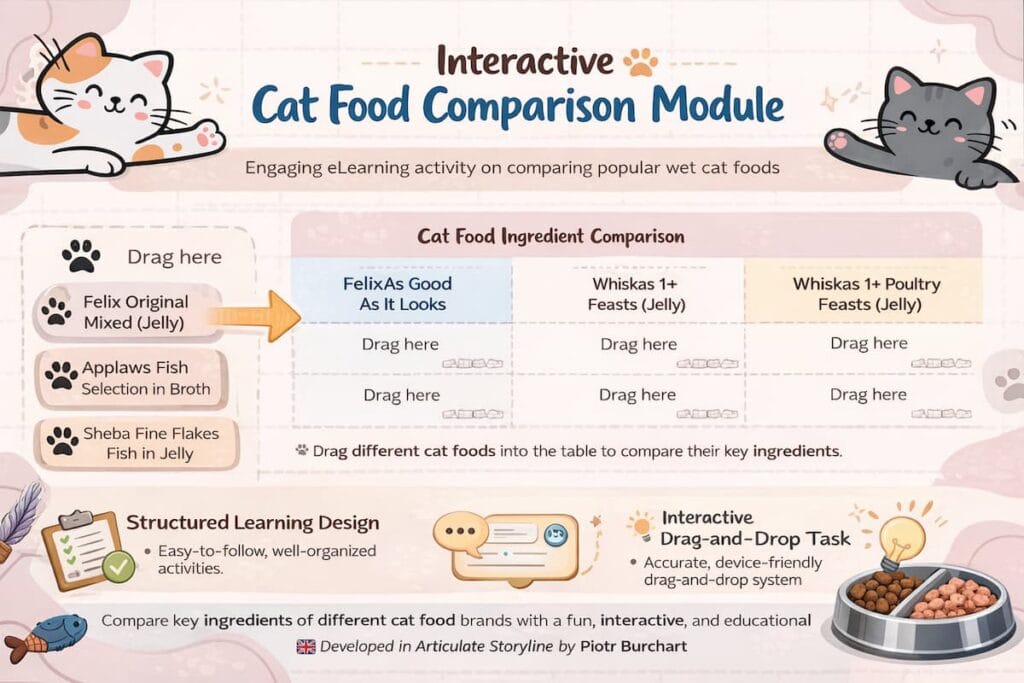
A central feature of this cat food comparison module is the use of drag-and-drop comparison interactions. Learners actively match food types with characteristics, reinforcing understanding through action rather than recall.
While the module itself is not complex in appearance, particular care was taken with interaction logic. Comparison activities rely on multiple conditions and feedback states, where even small trigger errors can lead to misleading outcomes. For that reason, interaction behaviour was designed carefully to prioritise accuracy, clarity, and consistency.
The module was developed as a self-contained interactive eLearning experience, designed for clarity, accessibility, and smooth navigation across devices. The build reflects the same principles applied across my wider eLearning Development services, including structured content, purposeful interactions, and reliable technical implementation.

This module was developed in Articulate Storyline, with particular attention paid to trigger order, condition logic, and feedback states. Drag-and-drop interactions were configured using bespoke triggers to ensure accuracy, prevent conflicting states, and allow the module to be updated or extended without breaking existing behaviour. This reflects real-world Storyline development, where careful trigger management is essential for reliable learner experiences.